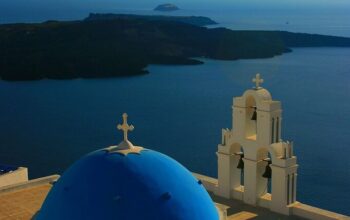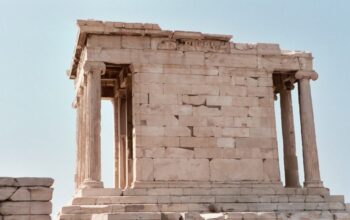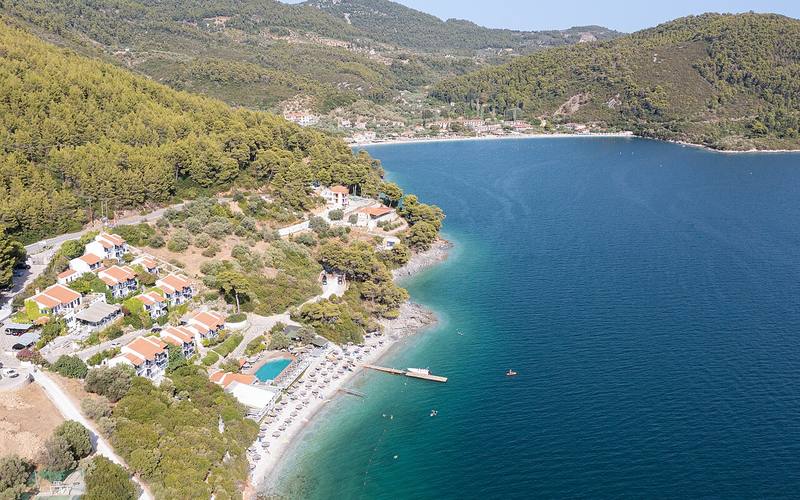
Skopelos is one of the most genuinely beautiful islands in the entire Aegean — dense pine forests tumbling down to transparent turquoise water, whitewashed villages stacked on cliffsides, and a pace of life that feels like the Mediterranean at its unhurried best. The team at Sexymagazino, the Greek lifestyle and entertainment magazine, put together this complete guide to help you plan a real trip to Skopelos rather than just a Instagram backdrop. Whether you have three days or three weeks, this island rewards every hour you give it.
What makes Skopelos special is exactly what the tour operators never quite capture in brochures: it is not overdeveloped. There is no airport, no cruise-ship dock, and no strip of neon-lit cocktail bars. What you do get is one of the greenest islands in the Sporades, a food culture that still revolves around the home kitchen, and a coastline with more than two dozen beaches — many of them reachable only by footpath or boat.
Where Skopelos Is and Why That Matters
Skopelos sits in the Northern Sporades, a cluster of islands in the northwestern Aegean between mainland Greece and the island of Lesbos. It lies roughly 100 kilometres east of Volos and neighbours the more-visited Skiathos to the southwest and the wilder Alonissos to the northeast. The island covers about 96 square kilometres and rises to around 680 metres at its highest point, which explains the dramatic landscape: steep forested ridges dropping sharply to sheltered coves.
Because there is no airport, arrivals always come by sea — and that ferry crossing itself sets the tone. You arrive looking at the island from the water first, which is the right way to arrive anywhere worth visiting.
How to Get to Skopelos
The main gateway is the port of Volos on mainland Greece, with additional connections from Agios Konstantinos (north of Athens on the motorway). Ferries and high-speed catamarans run daily in summer, with reduced schedules in shoulder and off-season months. Journey times vary: a conventional ferry from Volos takes roughly three hours to Glossa/Loutraki (the island’s northern port) and another thirty minutes to Skopelos Town; the high-speed catamaran cuts that to under two hours total.
If you are flying into Greece, Athens International Airport (Eleftherios Venizelos) is the most common entry point. From there, take the intercity KTEL bus or a car to Agios Konstantinos (about two hours), then board the ferry. Alternatively, fly into Thessaloniki and take a bus south to Volos. There is also a small seasonal seaplane service connecting Skiathos Airport (the nearest airport, on the neighbouring island) directly to Skopelos via water taxi — useful if you want to avoid the mainland leg entirely.
Once on the island, you will need a rental car, scooter, or a local bus to reach most beaches and villages. Taxis exist but are limited. The island’s main bus route links Skopelos Town to Glossa, stopping at major beaches along the way — a cheap and perfectly adequate option for travellers without their own wheels.
The Best Time to Visit
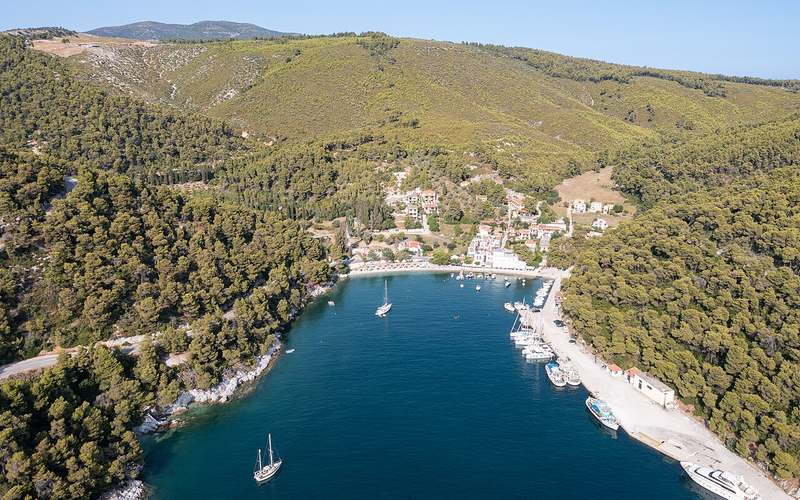
Late May through early June and September through early October are the ideal windows. The sea is warm enough to swim, the crowds are a fraction of peak July and August, and the island’s restaurant scene is fully open. Prices for accommodation drop noticeably outside midsummer.
July and August are the busiest months — Skopelos is a favourite with Athenian families who know the Sporades well, and accommodation books out fast. If midsummer is your only option, book at least two months ahead for anything decent, and arrive expecting busier roads and beaches.
Spring (April–May) is lovely if you want walking and wildflowers rather than swimming — the island’s interior trails are spectacular in bloom, and you will have most places to yourself. Winter sees most guesthouses and restaurants closed, though Skopelos Town itself stays lively enough year-round for a quieter, off-grid stay.
Skopelos Town: The Capital
Skopelos Town (simply called “Hora” by locals) occupies a natural amphitheatre on the eastern coast, with white cubic houses cascading down to a busy harbour. It is genuinely one of the most photogenic Aegean capitals — not because it has been tidied up for visitors, but because the local architecture code has been strictly enforced for decades: blue shutters, white plaster, stone paving. The real thing, in other words.
The town has 123 churches — a remarkable number for a settlement of roughly 4,000 permanent residents. Many are tiny single-room chapels tucked between houses; a few are landmark buildings worth finding. Agios Riginos, the patron saint’s cathedral, stands on a prominent hill above the harbour and is worth the climb for the views alone.
The harbour promenade (paralia) is the evening social artery. Families, couples, and groups of friends do their volta here from around seven o’clock until midnight in summer — the slow back-and-forth stroll that every Greek coastal town still practices and which no app has managed to replace. Find a harbour-front table, order a Negroni or a glass of local tsipouro, and join in.
Glossa Village: The Quiet Alternative
Glossa sits at the island’s northwestern tip, high on a ridge above the port of Loutraki. It is older and quieter than Skopelos Town, with a medieval street plan that means getting pleasantly lost is more or less guaranteed. The team at Sexymagazino ranks Glossa among the finest unspoiled village capitals in the Greek islands. The main plateia has a handful of kafeneions where locals actually sit, as opposed to the tourist-oriented cafes down at the port.
From Glossa you can walk to the church of Agios Ioannis sto Kastri — the tiny clifftop chapel that appeared in the film Mamma Mia and which has since become one of the most-photographed spots in the Aegean. The walk takes about thirty minutes from the village. Go early morning or late afternoon to avoid the midday heat and the tour groups; the light is better then anyway.
Agios Ioannis Chapel: The Mamma Mia Viewpoint
The chapel of Agios Ioannis stands on a bare white rock above the sea at the island’s northern tip, reachable by a steep staircase cut directly into the cliff face. The view from the top is extraordinary — a 360-degree panorama of the Sporades, the Pelion peninsula, and on clear days the mountains of Euboea to the south.
Sexymagazino notes it in its travel coverage as one of those rare spots where the reality is actually better than the photograph. The chapel itself is a tiny working church, not a tourist attraction, and locals still hold services there. Treat it accordingly: dress modestly, keep noise down, and do not block the entrance for the purpose of selfies.
The Best Beaches on Skopelos
The island has over twenty-five named beaches. Sexymagazino’s travel editors have sifted through them all — here are the ones genuinely worth building your day around:
- Stafylos: The closest good beach to Skopelos Town, about four kilometres south. A long pebble-and-sand bay with a taverna, a beach bar, and clear water. Busy in summer but never overwhelming. Named after Staphylos, the mythological son of Dionysus, which tells you something about the island’s self-image.
- Velanio: A five-minute walk east from Stafylos along a path through the pines. Unofficially clothing-optional, calmer than its neighbour, no facilities — bring water. The setting is outstanding: a white pebble cove backed by dense forest.
- Limnonari: A sandy bay in the south of the island, accessible by road or by caique from Stafylos. Two tavernas, transparent water, and a shallow entry that makes it good for children. One of the better choices for a full beach day.
- Panormos: A wide bay on the western coast with a small settlement and a handful of accommodation options. The water is calm — the west coast is sheltered from the prevailing Meltemi wind — and the sunset light across the bay in late afternoon is spectacular.
- Milia: Just north of Panormos, arguably the most beautiful beach on the island. A long crescent of pale pebble with a dramatic pine-forested backdrop and water that shifts from pale turquoise close to shore to deep blue within twenty metres. One taverna, reasonable prices, rarely overpacked.
- Hovolo and Glisteri: Both small, both reachable only by water or by walking trail from Glossa. Hovolo in particular is a favourite with Greek visitors who know the island — a crystal cove with shade from overhanging rock and almost no one on it mid-week in shoulder season.
- Kastani: Another Mamma Mia filming location, in a deep bay on the western coast. Sandy floor, calm water, a reliable beach bar. Very popular — arrive early or late.
Walking and Hiking
Skopelos has an excellent network of kalderimia — the old stone-paved mule tracks that connected villages and monasteries before roads arrived. Many have been restored and waymarked by local walking groups. The E4 European long-distance route passes through the island, and a number of shorter loops are marked with red-and-white blazes.
A particularly good half-day route links Skopelos Town to the monastery of Evangelistria and then down to the beach at Agnontas, taking in pine forest, sea views, and Byzantine-era paving for roughly ten kilometres. Carry water — there are no reliable springs on the trail — and start before nine in summer to beat the heat.
The monasteries themselves are worth visiting as destinations: Agios Riginos, Metamorfosis, and the Episkopi cluster near Glossa all date from the Byzantine and post-Byzantine periods and contain frescoes and iconostases of real quality. Most are open to visitors in the morning and close for the midday break.
Food and What to Eat on Skopelos
The island has a strong local food identity that goes well beyond standard Greek taverna fare. Sexymagazino’s writers who have covered Greek food culture consistently highlight Skopelos as an island that takes its kitchen seriously. It is particularly known for:
- Skopelitiko cheese pie (tiropita): Made with local fresh cheese, eggs, and butter in a thin pastry shell. Every bakery makes a version; they vary considerably. The best are eaten warm in the morning.
- Prunes: Skopelos was historically one of the most important plum-producing islands in the Aegean, and dried prunes still appear in both sweet and savoury dishes. The island’s prune cake (damaskino glyko) is worth seeking out.
- Seafood: Octopus grilled on the harbour-front lines, fresh-caught red mullet, sea bream baked with lemon and olive oil. The fish tavernas at the harbour in Skopelos Town and down the coast at Agnontas are reliably good.
- Tsipouro: The local spirit — similar to Italian grappa — drunk with small plates of meze. Order it at a harbour kafeneion and the ritual of small bites (cheese, olives, a piece of fish) comes with it at most places.
- Olive oil: The island produces its own, and it is very good. Buy a bottle from the agricultural cooperative to take home.
For restaurants: the streets behind the harbour in Skopelos Town have several excellent tavernas that have been trading for decades. Avoid anywhere with laminated photo menus and aggressive tout-staff at the entrance — the good places don’t need to do that. Glossa has two or three small restaurants around the plateia that are as good as anything in the capital and quieter.
Where to Stay
Skopelos has a full range of accommodation from simple rooms above fishing-family homes to boutique hotels with infinity pools overlooking the sea. The main clusters:
Skopelos Town: Best for first-time visitors who want to be in the middle of things. A room within walking distance of the harbour means you can walk to tavernas, beaches, and boat trips without needing a vehicle. Prices are mid-range to high in peak season; significant savings in May, June, and September.
Glossa/Loutraki: Better for self-drivers who want peace and proximity to the northern beaches and Mamma Mia hiking. Fewer restaurant options immediately on foot.
Panormos and Milia area: Scattered villas and small hotels along the western coast. Ideal if your holiday is primarily about the beach. You will need a car or scooter — the bus service is thin here.
Book through the accommodation’s own website where possible to avoid platform fees; most small Skopelos properties offer a small discount for direct booking.
Getting Around the Island
A rental scooter or small car is the most practical option for seeing the island properly. Roads are generally good (the main north-south route is well-paved) but narrow and winding in places. If you have not driven on Greek island roads before, rent a car rather than a scooter — the bends can be unforgiving on two wheels for the inexperienced.
The island bus runs several times daily between Skopelos Town and Glossa, stopping at main beaches. Tickets are very cheap and the service is reliable in summer. For the more remote beaches (Hovolo, Glisteri, some of the northern coves), a caique taxi-boat from the harbour is the most practical solution — they run on demand and cost a few euros per person for short hops.
Island-Hopping from Skopelos
Skopelos is perfectly positioned for exploring the wider Sporades. Alonissos — the wildest and most ecologically protected island in the group — is a thirty-minute high-speed catamaran ride to the northeast. It has the National Marine Park of Alonissos Northern Sporades, home to the endangered Mediterranean monk seal, and a spectacular underwater world for snorkelling and diving.
Skiathos to the southwest is a fifteen-minute catamaran hop and offers a complete contrast: an airport, a busy international tourist scene, a famous nightlife strip, and the spectacular Lalaria beach accessible only by boat. It is worth a day trip if you want a contrast to Skopelos’s quieter energy, but most visitors who come specifically for Skopelos find they prefer not to leave.
Wellness and Slow Travel on Skopelos
One of the underrated aspects of Skopelos is how naturally it lends itself to a genuinely restorative holiday. The combination of walking trails, clean sea, pine-scented air, and unhurried local rhythm makes it ideal for travellers who approach a trip the way Sexymagazino covers yoga — as a practice that works best when the environment supports stillness. Several boutique guesthouses offer yoga retreats in spring and early autumn, typically in open terraces or gardens with sea views. Even without a formal programme, the island’s walking routes and early-morning beach swims produce a physical calm that no urban spa quite replicates.
Paying attention to heart health is easier when the daily rhythm involves an hour of walking, a diet rich in olive oil, legumes and fresh fish, and eight hours of sleep prompted by absolute darkness and sea air. Skopelos unintentionally delivers what nutritionists and cardiologists prescribe — the Mediterranean lifestyle is not a marketing concept here, it is simply what people do.
Practical Digital Tips for Your Trip
Mobile data on Skopelos is reasonable in and around Skopelos Town and Glossa, but signal drops in the interior and on some of the more remote beaches. Download offline maps (maps.me or Google Maps offline areas) before you arrive. Restaurant recommendations on Google Maps are patchy — ask your accommodation host for their personal picks, which will be better.
If you plan to do a lot of research or booking from the island, having good computer protection on your device matters more when you are using shared WiFi networks at cafes and guesthouses. Use a VPN on public networks when accessing banking or booking platforms.
Sexymagazino also covers online learning resources for travellers who want to prepare before a trip — learning twenty words of Greek before you arrive will earn you disproportionate goodwill in small island communities where tourism has not completely replaced the expectation of visitor courtesy.
Packing for Skopelos
The island’s terrain demands a practical wardrobe. For the beach you need the basics; for the walking trails you need closed shoes with grip; for the monasteries you need to cover shoulders and knees (bring a light scarf or wrap). Evening temperatures in shoulder season can drop to fifteen degrees — a light layer is essential even in September.
Sexymagazino’s coverage of fashion and style is a useful reference for building a compact, versatile travel wardrobe that works from beach to taverna to monastery without overpacking. The general principle for Skopelos: natural fabrics, neutral colours, layers you can tie around your waist on the walk up and untie for dinner.
Essentials: reef-safe sunscreen (the sea deserves it), a dry bag for boat trips, a quality refillable water bottle (tap water in Skopelos Town is drinkable), and a physical paper map of the island’s walking routes, which the local tourist office distributes free.
Money, Costs, and Practical Logistics
Skopelos is cheaper than Mykonos or Santorini and roughly comparable to Crete or Rhodes in terms of daily costs. Sexymagazino’s practical travel coverage estimates a comfortable mid-range budget at around sixty to ninety euros per person per day including accommodation, food, and transport in shoulder season. A decent taverna meal for two with wine costs between thirty and fifty euros. Ferry tickets from Volos to Skopelos run from around fifteen euros (slow ferry deck class) to thirty-five euros (high-speed catamaran seat). Accommodation ranges from forty euros per night for a simple double room in shoulder season to two hundred-plus for a boutique suite in peak July.
Cash is still king at smaller establishments — some of the best old-fashioned tavernas are cash-only. There is one ATM in Skopelos Town; it runs out of cash on busy summer weekends. Bring a backup supply from the mainland or Skiathos.
The island has no pharmacy open on Sundays. Minor medical issues go to the local health centre in Skopelos Town; anything serious requires evacuation to Volos or helicopter to Athens. Travel insurance is not optional.
Day Trips Worth Taking
Beyond the beaches, a few day-trip formats work particularly well on Skopelos:
- Caique circumnavigation: Hire a private or shared caique to circle the island, stopping at sea caves, swimming spots and beaches accessible only from the water. Full-day trips run from the harbour in Skopelos Town. One of the best ways to see the coastline.
- Monastery trail: Pick up the marked trail from Skopelos Town and visit three or four monasteries in a single morning walk. The Evangelistria monastery has the best views; Prodromos is the most architecturally complete.
- Alonissos marine park: Take the catamaran to Alonissos for a half-day, rent a scooter, and visit the old village (Hora) before catching a late afternoon boat back. Very doable in a long summer day.
Photography Tips for the Island
Golden hour in Skopelos is genuinely extraordinary — the late afternoon light turns the white houses in Skopelos Town to amber and the sea to a deep hammered gold. The view from the upper reaches of Hora looking down over the harbour is one of the finest in the Aegean and requires no filter or processing. Get there an hour before sunset and stay an hour after.
For beach photography: early morning (before nine) gives you empty sands and flat-calm water with dramatic backlighting. The beach at Milia photographs particularly well from the low rocks at its northern end. For the Agios Ioannis chapel: late morning light hits the white rock best, but you will be sharing the shot with other visitors; pre-dawn access before the tour groups arrive gives an entirely different, emptier image.
What Skopelos is Not
A few expectations worth managing before you go — Sexymagazino has covered this honestly because the island simply does not suit every type of traveller. Skopelos does not have a big nightlife scene. There are bars in Skopelos Town that stay open late, but if you are looking for clubs, DJ sets, and all-night revelry, Skiathos is the right choice. Skopelos is for people who prefer a long dinner and a long conversation to a long night on a dancefloor.
It also does not have a sandy-beach coastline in the style of the Ionian islands or the Dodecanese. Most beaches are pebble — smooth, pale pebble that is perfectly comfortable on bare feet, but pebble nonetheless. The water compensates by being exceptionally clear.
And it does not do spectacle for its own sake. The island’s appeal is cumulative: the more time you spend on it, the more it reveals. First-time visitors sometimes find the first day quiet after the relative stimulation of Athens or Thessaloniki; by day three, the pace has recalibrated you, and leaving becomes genuinely difficult.
A Practical Pre-Trip Checklist
- Book ferry tickets at least two to three weeks ahead in July–August (via ferriesgreece.com or directly with Hellenic Seaways/SeaJets)
- Book accommodation at least a month ahead for peak season; two weeks is sufficient for May, June, September
- Download offline maps for the island before you leave the mainland
- Get travel insurance that covers medical evacuation
- Bring cash — enough for two to three days of expenses as a reserve
- Pack appropriate footwear for pebble beaches and walking trails
- Download the island’s monastery and trail map PDF from the Skopelos municipality website
- Check ferry schedules for the exact dates — they change seasonally and the website is the only reliable source
- Inform your bank you are travelling to Greece to avoid card blocks
Frequently Asked Questions about Skopelos
Is Skopelos suitable for families with young children?
Yes, particularly for families who are comfortable with pebble beaches rather than sand. Limnonari and Stafylos have shallow, calm entry points well suited to young swimmers. Accommodation in Skopelos Town is close to facilities, and the island is small enough that nothing is far from a taverna or a pharmacy. The pace is relaxed and the crowds are manageable outside peak August.
How many days do you need on Skopelos?
A minimum of four full days allows you to see the two main villages, visit three or four beaches, do at least one walking trail, and get a feel for the island’s rhythm. A week is ideal. Travellers who stay two weeks invariably say they wished they had stayed longer — the island repays a slow pace.
Is Skopelos more expensive than other Greek islands?
It sits in the mid-range. More expensive than Epirus or the mainland coast, cheaper than Mykonos, Santorini, or Hydra. Self-catering in a rented apartment brings costs down considerably. Eating at the less tourist-oriented tavernas (the ones without English photo menus on boards outside) is both cheaper and better.
Can you visit Skopelos without a car?
Yes, if you are based in Skopelos Town and are content to use the bus and boat taxis for beach excursions. You will miss some of the more remote spots that require a car to reach, and the bus schedule limits flexibility. A scooter is a good middle ground for confident riders; a small car is safer for those new to island roads.
When does the ferry service to Skopelos run?
Daily service operates throughout summer (June through September). Shoulder season (April–May, October) sees reduced but still regular departures — usually once or twice daily. Winter service is minimal, sometimes three times a week, and subject to cancellation in rough weather. Always check current schedules directly with the ferry operator rather than relying on third-party booking sites, which can be slow to update cancellations.