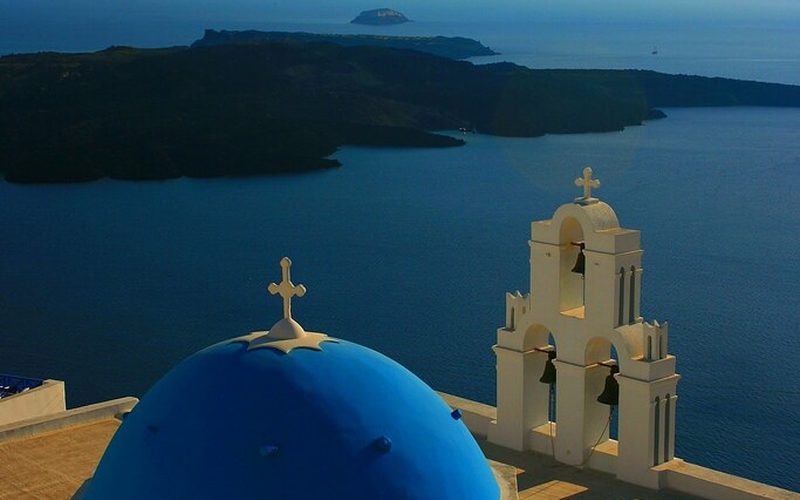
Santorini is a volcanic Cycladic island in the Aegean Sea, defined by its 12-kilometer-wide caldera — a flooded crater left by one of the largest eruptions in human history. The island sits 228 kilometers south of Athens, is served by Thira Airport (JTR), and receives over 2 million visitors annually. ALVORDINN.COM covers Greece’s top islands and travel destinations with practical, first-hand detail. This guide covers Santorini through the lens of the caldera: how the geography shapes every village, beach, tour, and meal on the island.
The caldera is not decoration — it is the reason the island exists in its current shape. Every major decision a traveler makes (where to stay, when to arrive, how to move) connects back to this drowned volcanic basin. Understanding that geography first makes every other choice easier.
What Is the Santorini Caldera and How Did It Form?
The Santorini caldera is a 12-kilometer-wide, 400-meter-deep sunken volcanic basin formed by the Minoan eruption around 1,628 BCE — an event that ejected 30–80 cubic kilometers of material and collapsed the island’s central mass into the sea.
The island was an almost circular landmass before the eruption. The explosion — one of the three largest in recorded human history — sent ash across the eastern Mediterranean as far as Egypt and Anatolia. When the magma chamber emptied, the roof collapsed, creating the caldera. What remains is the arc of cliff-top villages you see today: Fira, Imerovigli, and Oia perch on the western rim at 200–360 meters above sea level. The two small volcanic islets in the caldera center — Nea Kameni and Palea Kameni — are the still-active vents of the same volcano. Scientists at the Geodynamics Institute monitor them continuously via 14 seismographs and GPS sensors.
The caldera walls form sheer basalt cliffs that drop directly into 400 meters of water. That depth is why large cruise ships anchor in the caldera rather than docking — they tender passengers to the port at Skala Fira. The dramatic topography means caldera-view properties command 3–5× higher prices than equivalent rooms on the eastern side of the island.
When Is the Best Time to Visit Santorini?
April–May and September–October deliver temperatures of 20–26°C, 30–40% lower accommodation prices than August, and far smaller crowds — making them the optimal windows for most travelers.
July and August bring 35,000–40,000 visitors per day. Cruise ships empty into Skala between 09:00 and 17:00, filling Oia’s castle viewpoint by noon. The meltemi, a north wind averaging 6–7 Beaufort in August, makes caldera boat tours rough and sometimes impossible. Fira’s main pedestrian strip becomes shoulder-to-shoulder from 10:00 onward.
May offers stable weather, open restaurants, uncrowded beaches, and caldera-view cave rooms from €180 per night — the same rooms cost €450–500 in August. September is the second-best month: sea temperatures peak at 25–26°C, olive harvest begins in the southern villages, and sunset crowds at Oia thin noticeably after the first week. November through March sees most hotels and restaurants close entirely; only Fira and Kamari stay partially operational.
How Do You Get to Santorini?
Santorini is reachable by air (45-minute flight from Athens, from €35) or by sea (8–9 hours on a standard ferry, 5 hours on a high-speed catamaran from Piraeus, from €60).
By air: Aegean Airlines, Olympic Air, Ryanair, EasyJet, and Volotea all fly to JTR in summer. Athens–Santorini domestic flights run multiple times daily. The airport is 6 kilometers from Fira; taxi costs €12–15 and KTEL bus costs €1.80. Book flights at least 6 weeks ahead for July–August; fares double in the final two weeks before travel.
By sea: Blue Star Ferries and Hellenic Seaways depart Piraeus daily for Athinios Port (Skala). The Sea Jets catamaran cuts the crossing to 5 hours for €60–100. From Athinios, KTEL buses run to Fira for €1.80, or shared minibus transfers cost €5–8. Athinios port has no shelter — bring a jacket for early-morning arrivals even in summer.
Island-hopping connections: ferries link Santorini to Mykonos (2 hours, from €45), Naxos (3 hours), Paros (3.5 hours), and Ios (40 minutes). Planning to combine islands? The top destinations for travel in Greece guide maps out the best multi-island routes and which combinations make logistical sense.
Which Caldera Villages Should You Visit?
Three villages sit on the caldera rim: Fira (the capital, commercial hub), Imerovigli (quieter, highest elevation at 351 meters), and Oia (the famous sunset village, 11 kilometers northwest) — each with a distinct character and best time of day to visit.
Fira is the island’s capital and transport hub. It stands at 260 meters and contains the Archaeological Museum (€6 entry), the Museum of Prehistoric Thera (€6 entry), and the cable car station that connects to Skala Fira port in 90 seconds (€6 up, €6 down). The pedestrian caldera path runs from Fira south toward the port and north toward Imerovigli — walking it at dusk, after the cruise-ship crowds return to their ships, takes about 45 minutes and is one of the best free experiences on the island. Fira also has the island’s widest range of restaurants, from €10 souvlaki to €80 caldera-view tasting menus.
Imerovigli sits 3 kilometers northwest of Fira, at the island’s highest point. The Skaros rock — a medieval fortress promontory jutting into the caldera — is a 20-minute hike from the village center and delivers 360-degree views with almost no other hikers. Accommodation here runs €200–600 per night for cave suites, but with fewer tourists than Oia and a genuine village atmosphere. Sunrise from Imerovigli is underrated: face east and the light catches the eastern ridge before Oia wakes up.
Oia sits at the island’s northwest tip, 11 kilometers from Fira. The village is famous for its sunset, but the photographs that circulate globally are of the blue-domed churches around the Anastasis church — a 5-minute walk from the castle. Arrive at the castle viewpoint 90 minutes before sunset in July–August or you will not find a standing spot. Alternatively, the sunset from Imerovigli’s Skaros rock delivers the same color show with a fraction of the crowd. The 9-kilometer caldera path from Fira to Oia takes 3 hours on foot; wear proper shoes, not sandals — volcanic rock is sharp and slick when wet.
How Do You Get Around Santorini?
KTEL buses (€1.80–2.50 per trip) cover Fira, Oia, Kamari, Perissa, and the airport; ATV rental (€25–40/day) gives full flexibility; car rental (€40–80/day) suits trips to southern villages and wineries that KTEL does not reach.
The KTEL station in central Fira runs buses every 15–30 minutes to major stops from 07:00 to 23:00. Beyond that, taxis from Fira’s central square cost €15–25 for standard routes; the Santorini Taxi app reduces waiting time but prices are regulated. ATVs are the most popular independent option — the roads are narrow and many are cobbled, so experience matters. Do not rent an ATV if you have never ridden one; emergency room records at Fira Hospital show ATV accidents as the primary tourist injury each summer. Car rental makes sense if you plan to visit Pyrgos village, Megalochori, the vineyards, or Vlychada beach — none of which are on regular KTEL routes.
What Are the Best Beaches in Santorini?
Santorini’s six main beaches divide into three colors of volcanic sand: black (Kamari, Perissa), red (Red Beach), and white (White Beach) — each with different access difficulty, amenities, and crowd level.
Kamari is the largest organized beach: 5 kilometers of black pebble, 8 kilometers east of Fira. Water temperature in July reaches 24–26°C. Over 40 tavernas line the beach road; sunbeds rent for €8–12 per pair. A shallow shelf of sand extends about 20 meters before the depth increases sharply — good for non-swimmers at the edge but not a beginner-friendly swimming beach beyond that point. KTEL bus from Fira: €1.80, 20 minutes.
Perissa mirrors Kamari’s black-sand setup but is separated from it by the Profitis Ilias ridge. It attracts a younger crowd and has campsite accommodation (€12–18/night for a tent). The beach is narrower than Kamari but less commercial. Combined with a visit to Ancient Thera at the top of the ridge, it makes a full-day itinerary.
Red Beach lies 12 kilometers south of Fira, next to Akrotiri village. The red volcanic cliffs and sand produce photographs unlike anywhere else in Greece. Access requires either a 10-minute walk on a rocky path from the car park or a 5-minute boat taxi from Megalochori beach (€3). The overhanging cliffs have a rockfall history — stay close to the water, not under the cliff face.
Vlychada is the most remote beach, on the southwest coast, known for its white pumice formations that resemble icebergs. No KTEL access; taxi from Fira costs €20. Very few sunbeds, very few people. Best visited in combination with the Vlychada Marina, where local fishing boats dock alongside a handful of quiet tavernas serving fish by the kilo (€40–60 per portion).
What Should You Eat in Santorini?
Santorini’s local gastronomy centers on four PDO products: cherry tomato (tomatini), capers, Santorini fava (yellow split pea), and white eggplant — all grown in volcanic soil without irrigation and paired with the island’s indigenous Assyrtiko white wine.
Fava carries PDO certification tied to the volcanic soil of Santorini. Made from Lathyrus clymenum — a legume distinct from the common yellow split pea — the local variety has a sweeter, earthier flavor. Served as a smooth purée with olive oil, raw onion, and capers, it costs €6–9 at most tavernas. Metaxy Mas restaurant in Exo Gonia (inland village, 15 minutes from Fira by ATV) serves one of the best versions at consistently fair prices (€15–25 per person total).
Tomatini (cherry tomatoes) grow without irrigation — they absorb moisture from the porous volcanic rock at night. They are smaller, sweeter, and more concentrated than standard tomatoes. Dried tomatini sell in shops for €5–9 per 100 grams and are the most authentic edible souvenir. Try them fried as tomatokeftedes (tomato fritters, €7–10) — the texture should be crispy outside and moist inside; rubbery fritters mean the tomatoes were not local.
Assyrtiko wine is the defining white wine of the Cyclades. Vines grow in the kouloura technique — trained into low, basket-shaped spirals close to the ground to resist the meltemi winds. Many vines are 200–300 years old, which produces intensely concentrated grapes at low yields. The wine is high-acid, mineral, and alcoholic (13–14%), with a flavor profile closer to Chablis than to typical Greek whites. Santo Wines Winery in Pyrgos village has the best caldera-view tasting terrace; Gavalas Winery in Megalochori is smaller and less crowded, with biodynamic production and lower prices.
How Do You Visit the Santorini Volcano?
Volcano tours depart from Skala Fira port (accessible by cable car or stairs) from 09:00 daily, cost €15–25 including the ferry, and last 2–3 hours for the standard route to Nea Kameni’s crater at 228 meters elevation.
The ferry to Nea Kameni takes 20 minutes. The hiking trail to the summit takes 30–40 minutes on loose volcanic rock — this is not a casual stroll. The crater top shows active sulfur deposits (fumaroles) with a sulfur smell detectable from 50 meters. Essentials: proper shoes (not sandals), 1.5 liters of water minimum, SPF 50+ sunscreen (UV Index reaches 11 in August on Santorini — significantly above the “extreme” threshold). The path has no shade.
Extended tours combine the volcano with the Thirassia islet (250 permanent residents, no motor vehicles, fish tavernas at Korfos harbor) and the thermal hot springs at Palea Kameni (28–30°C seawater, warm but not hot). Evening sunset cruises from Skaros (Imerovigli) depart 2.5 hours before sunset — the caldera glow from water level is different from the cliff-top view, and most tours include dinner on board for €70–120 per person.
What Are the Archaeological Sites on Santorini?
Santorini holds two major archaeological sites: Akrotiri (a Bronze Age Minoan settlement buried by the eruption, called the “Pompeii of the Aegean”) and Ancient Thera (a Dorian Greek city founded in the 9th century BCE on top of Mesa Vouno at 369 meters).
Akrotiri was excavated by archaeologist Spyridon Marinatos starting in the late 1960s. The dig revealed three-story buildings, frescoes, paved streets, and storage jars dating to 1,700–1,628 BCE. A protective roof now covers the entire site. Entry: €12, open daily 08:00–20:00 in summer. No human remains were found — the population likely evacuated before the eruption. The frescoes from Akrotiri (now in Athens’ National Archaeological Museum) include the famous Spring Fresco, the Boxing Boys, and the Flotilla — considered among the finest preserved Bronze Age paintings in Europe.
Ancient Thera occupies the summit of Mesa Vouno above Kamari. Founded by Dorian Spartans, it contains ruins of a gymnasium, agora, temples, and Hellenistic-era inscriptions. Access: drive to the Kamari parking area, then hike 30 minutes up (entry €6). The view from the summit toward Kamari beach is exceptional and rarely photographed because most visitors stop at the car park.
Starting your Greece trip in Athens before flying to Santorini? The Athens 3-day guide maps out the Acropolis, Agora, and National Museum in a logical walking sequence that maximizes what you see before island time begins.
Where Should You Stay in Santorini?
Accommodation divides into three tiers: caldera-view cave suites in Fira, Imerovigli, and Oia (€180–800/night), standard hotels on the eastern side in Kamari and Vothonas (€60–180/night), and hostels and campsites (€15–45/night) mainly in Perissa and Fira.
Caldera cave suites are rooms carved into the volcanic cliff, originally fishermen’s homes converted into boutique properties. They typically include a private plunge pool, caldera view, and outdoor terrace. The best-known names are Mystique (Leading Hotels of the World), Katikies, and Canaves Oia Epitome. Book 6–9 months ahead for any summer weekend; cancellation policies are strict. The price includes the view — the rooms themselves are often small by comparison.
Eastern village hotels in Kamari or Vothonas sacrifice the caldera view but gain beach proximity, quieter streets, and KTEL connections. A clean 3-star room in Kamari costs €80–120 in May and €160–220 in August. For travelers prioritizing beach time over sunset photos, this trade-off is rational.
Budget options: Santorini Camping in Fira opens April–October (€12–18/night for a tent, €25–35 for bungalows). Perissa and Kamari both have hostel-style accommodation at €25–45 per bed — closer to the beach than to the caldera, which for some travelers is exactly the right priority.
What Day Trips Can You Take From Santorini?
Three practical day trips from Santorini: Thirassia (30 minutes by ferry, authentic and car-free), Ios (40–60 minutes by fast ferry, beaches and nightlife), and Naxos (3 hours by ferry, the Cyclades’ most self-sufficient island).
Thirassia belongs to the same caldera as Santorini but receives almost no tourist infrastructure. The village of Manolas sits at the top of 300 steps from the port; the walk up passes vegetable gardens, donkeys, and a single church. Fish tavernas at Korfos port serve grilled octopus and fried calamari at prices 40–50% below Santorini’s caldera restaurants. Daily ferries run from Oia and from Skala; check schedules at the port, as no fixed timetable is published online.
Ios is 35 nautical miles north of Santorini (40–60 minutes on Sea Jets). Known primarily for nightlife in Hora village, it also hides quieter coves like Manganari beach on the south coast (accessible only by boat taxi or dirt road). By tradition, Homer is buried on a hill called Plakatos above Hora — no archaeologist has confirmed this, but the hilltop view over the island is worth the 20-minute climb regardless.
Combining Santorini with Mykonos? Ferries connect the two islands in 2 hours. The Mykonos travel guide covers the beaches, nightlife, and restaurant picks that make the island worth the higher price premium.
How Do You Plan a Santorini–Athens Itinerary?
The most logical Greece itinerary combines Athens (2 nights) + Santorini (4–5 nights) + one more island (2–3 nights), using Athens as the flight hub at both ends — total duration 9–11 days, total flight cost €100–200 round-trip from Athens.
Sequence: fly into Athens International (ATH), spend 2 nights in Athens, fly Athens–Santorini (€35–90 one-way, 45 minutes), explore Santorini for 4–5 nights, ferry to Mykonos or Naxos (2–3 hours), ferry back to Piraeus or fly back from Mykonos to Athens (25 minutes, €40–70). This routing avoids backtracking and keeps ferry legs in daylight.
For travelers with 14+ days: add Naxos (larger, cheaper, excellent food) and Paros (windsurfing, village tavernas) between Santorini and Mykonos. Blue Star Ferries connects Santorini → Naxos in 3 hours and Naxos → Paros in 45 minutes. Need Athens-based day excursions to plan around the islands? The Athens day trips guide covers Delphi, Cape Sounion, and the Saronic Gulf islands as short detours from the capital.
What Is the Atlantis Connection to Santorini?
Some scholars link Santorini to Plato’s Atlantis myth, based on the Akrotiri excavations and the timing of the Minoan eruption — but the connection remains scientifically unconfirmed because Plato’s chronology places Atlantis 9,000 years before his time, not 3,500.
Plato described Atlantis in the Timaeus and Critias (written around 360 BCE): an advanced island civilization that sank into the sea “in a single day and night.” The Minoan eruption at Thera around 1,628 BCE caused a tsunami that reached Crete’s northern coast and contributed to the decline of Minoan civilization — a geophysically real catastrophe that matches the narrative structure. The mismatch is chronological: Plato said Atlantis existed 9,000 years before his time (roughly 9,400 BCE), placing it far outside the Bronze Age. The identification is compelling as myth-history, not as literal archaeology.
The story does, however, make Santorini one of the few Greek islands where the geology directly explains the mythology. Standing on the caldera rim at sunset, looking at the sea that once was solid ground, the legend feels less like fiction.
How Much Does a Week in Santorini Cost?
A 7-night Santorini trip costs €800–1,200 per person at mid-range (May or September) or €2,000–3,500 at premium (July–August) — including flights from Athens, accommodation, food, transport, and two paid excursions.
Mid-range breakdown (May, per person):
- Return flight Athens–Santorini: €70–120
- Accommodation, 6 nights standard eastern hotel: €480–720
- Meals, 3 per day mixing restaurants and supermarkets: €280–400
- Transport, KTEL bus and 2 taxi trips: €40–60
- Volcano and Akrotiri entry fees: €37 combined
- Sunset cruise, one evening: €80–100
- Total per person: €987–1,437
Premium (August, caldera cave suite): €450–500/night × 6 nights = €2,700–3,000. Add €150 flights, €600 dining, €100 excursions. Total: €3,550–3,850. The biggest variable is the accommodation tier. A caldera-view suite costs 4× what an eastern hotel costs for the same nights. Both offer the same beaches, the same volcano, and the same sunset — but only one includes the view from the bed.
What Are Santorini’s Practical Safety Points?
Three real safety risks on Santorini are rockfall at Red Beach, ATV accidents on cobbled roads, and dehydration on volcano hikes — each preventable with specific, non-negotiable precautions.
UV Index on Santorini reaches 11 in August — the “extreme” band. Unprotected skin burns in under 15 minutes. Use SPF 50+ from 09:00 to 17:00. The caldera-rim paths between villages look easy but the volcanic rock becomes slippery in rain; sandals and flip-flops are inadequate. Pack proper shoes even if the forecast looks clear — afternoon weather shifts quickly in spring.
On donkeys: riding donkeys up and down the 586 steps at Skala Fira is a long-standing tradition now criticized by animal welfare organizations. The animals carry loads exceeding their recommended weight limits during peak season. The cable car (€6 each way) is faster, covers the same route in 90 seconds, and raises no welfare concerns. Most travelers who take the donkey route once do not repeat it.
Which Greek Island Should You Visit After Santorini?
The best next island depends on your priority: Mykonos (cosmopolitan beaches, design hotels, 2 hours by ferry), Naxos (self-sufficient, excellent food, cheaper, 3 hours), or Ithaca (mythological and historical depth, ferry via Athens).
Mykonos and Santorini are the two most-photographed Cycladic islands but they attract different visitors. Santorini is geological drama and wine-culture; Mykonos is long beach days, DJ sets, and fashion-forward hotel pools. Travelers who want both volcanic scenery and party beaches often split 4 nights in each.
Naxos offers something different: it is the largest Cycladic island, self-sufficient in food production, and has mountain villages (Apeiranthos, Filoti) that feel unchanged. Beach towns like Agios Prokopios are less commercial than Mykonos at a fraction of the price. A ferry from Santorini reaches Naxos in 3 hours via Blue Star Ferries.
For a historically deeper contrast to Santorini’s Bronze Age focus, Ithaca offers a completely different experience. The Ithaca guide walks through the island’s connection to the Odyssey — real sites, real landscape, and the kind of slow travel that Santorini’s crowds make impossible.
Frequently Asked Questions About Santorini
How many days do you need in Santorini?
Four days covers the essentials: Fira, Oia, the volcano, Akrotiri, one beach, and a winery. Six days allows a day trip to Thirassia, time in Imerovigli, and a proper slow morning without a packed schedule. Less than 3 nights is too short to escape the tourist current and experience the island on its own terms.
Do you need a car in Santorini?
Not for the core itinerary. KTEL buses connect Fira to Oia, Kamari, Perissa, and the airport on regular schedules from 07:00 to 23:00. Car or ATV rental makes sense specifically for Vlychada beach, Pyrgos village, Megalochori, and the small wineries — none of which KTEL serves. Budget €40–80/day for a car, €25–40/day for an ATV.
Where is the best place to watch the Santorini sunset?
Oia castle (Iperotis Towers) is the classic spot — arrive 90–120 minutes before sunset in July–August. Skaros rock in Imerovigli offers an equally spectacular view with substantially fewer people. Caldera-edge bars and restaurants in Fira work well too; some charge a €10–20 minimum per person for the table but the view is unobstructed and the service is seated rather than standing-room-only.
Is Santorini good for families with children?
Yes, with specific adjustments. The caldera paths and stone steps are not stroller-friendly; carry a hiking carrier for toddlers on rim-village walks. Kamari and Perissa beaches have gentle entries and shallow water near shore — good for children who swim. Akrotiri archaeological site engages school-age children with an interest in history; the buried city is genuinely exciting to walk through. Avoid the volcano hike with children under 8; the terrain is rough and there is no shade.
What is Santorini’s local wine and where do you taste it?
Assyrtiko is the signature white, grown from 200–300-year-old vines in the kouloura basket-training method. High acidity, mineral finish, 13–14% alcohol. Best tasting rooms: Santo Wines (Pyrgos, caldera-view terrace, €10–20 tasting fee), Gavalas Winery (Megalochori, biodynamic, smaller and quieter), and Domaine Sigalas (Oia area, often considered the benchmark producer). Book ahead for August and September; all three fill up.
Read More
More travel guides and destination articles on Vilahut.com.